

iowa, recipes

A Return to Home: Homemade Lefse Recipe

03/24/2015

Lefse Recipe on This American House

In many ways, buying this house in northeast Iowa has felt like returning home for us. This despite the fact that neither of us are from Iowa. For me it’s a return to the small town life that I knew growing up. And for The Mister we’re once again in a region of the country that proudly celebrates its (and his) Norwegian heritage. And just like in his native Fargo, North Dakota, that Norwegian heritage means that there’s lefse in grocery stores.

Lefse is a Norwegian flatbread that I, a small town boy with southern roots, had never encountered until I met The Mister. It’s kind of like a tortilla but it’s made out of potatoes. And whereas a tortilla is stuffed with meat and cheese and other fixings, lefse is simply smeared with butter, rolled up and eaten as is.

Enjoying Homemade Lefse at This American HouseI was introduced to lefse on our our first visit to The Mister’s parents’ house in Fargo. It was one of the first things we were presented by The Mister’s adoring and adorable mother, Louise. We were kids then, The Mister and I, and so of course we had made the entire twelve hour drive in the dark. After The Mister picked me up from work on a dark February Friday, we set out on our first road trip together. We had only met the month before but we were already quite smitten and this trip was one of those “take him home to meet mother” deals. To say that I was nervous is an understatement. Fortunately Louise made me feel right at home, even as she had to explain lefse to me.

Over the years I’ve found ways to bring this Norwegian treat into our lives. One Christmas I ordered a box of Freddy’s Lefse, The Mister’s preferred brand made in his hometown, as a surprise treat. And on every visit to Fargo we’ve picked up a package or two to take back to the city with us. While it has yet to become my favorite food, I appreciate the heritage and, more importantly, the memories associated with lefse.

It was during our first weekend in This American House that I spied packaged lefse for sale in the local grocery store. I purchased a couple packages and excitedly brought them back to the house. “You’re home!” I said to The Mister, and held up the packaged lefse to illustrate the point.

Like anything, packaged lefse is only half as good as homemade. The Mister has often told me how delicious his grandmother’s homemade lefse was. There was always a sense of wistful longing in his voice when he would say this. I’ve heard stories about how his dad had taken a class to learn how to make it and how his lefse was almost as good as his grandmother’s. Stumped for a birthday gift this year, and now that we have a house with the space to store it, I bought The Mister an 8 Piece Lefse Starter Kit  . And now I understand what he was raving about all those years. Homemade lefse is delicious!

We set up shop in the dining room for our inaugural lefse experiment. As an experienced baker, I was pretty confident that I’d be able to follow the lefse recipe that came with the kit. And except for a few oopses along the way, our first batch of lefse turned out quite nicely. Here’s how it’s done:

Making Homemade Lefse at This American House

HOW TO MAKE LEFSE

1. Make mashed potatoes. (Or, if you’re pressed for time, make a batch of instant mashed potatoes.) Let cool.

2. Add equal amounts of flour as potatoes. For instance, if you have 2 cups of mashed potatoes, add 2 cups of flour.

Lefse Dough

3. Form the potato mixture into balls that are roughly the size of tennis balls.

4. Chill the potato dough balls overnight.
Rolling Lefse on a Floured Surface

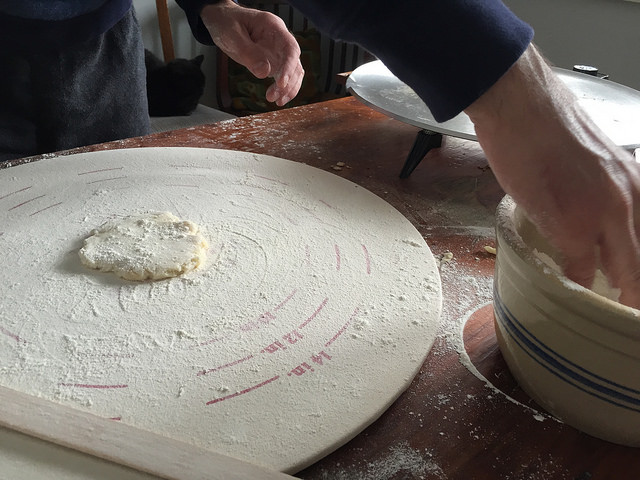
5. The next day, place the chilled ball of dough on a well floured surface. (This handy board and cover were included in The Mister’s lefse kit.  You can also roll your dough on a counter top or large cutting board.) Smoosh the dough to flatten it a little.

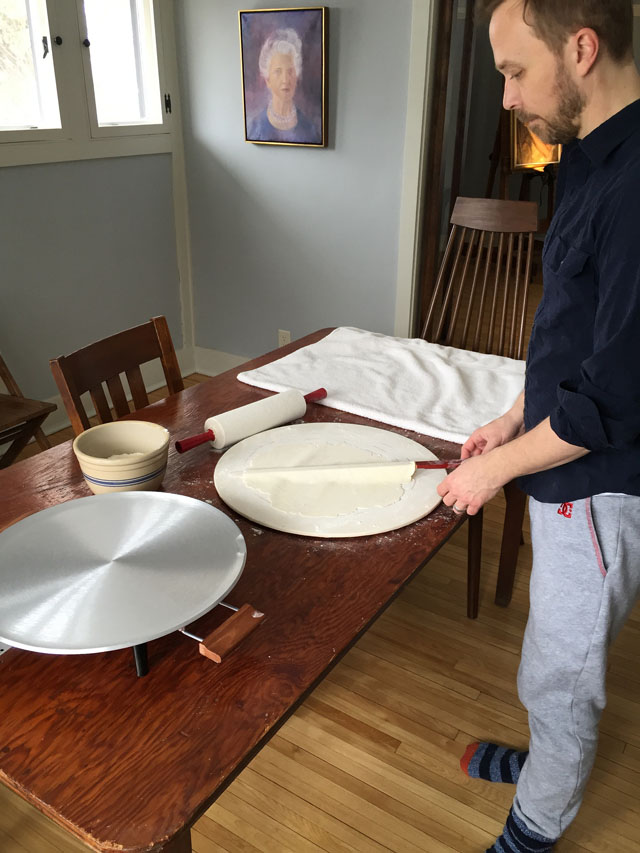
Making Homemade Lefse at This American House5. Use a rolling pin to roll the dough into a very thin disk. As The Mister’s high school friend and fellow lefse lover advised, you want the rolled dough to be the consistency of a paper towel. That is, you want it to be super thin and almost transparent.
Making Lefse at This American House

6. Our lefse kit came with a turning stick, which is an invaluable tool when you’re dealing with such a thin dough. The turning stick is used to lift the dough off the pastry board and place it on the grill.
Lefse Cooks on a Grill at This American House

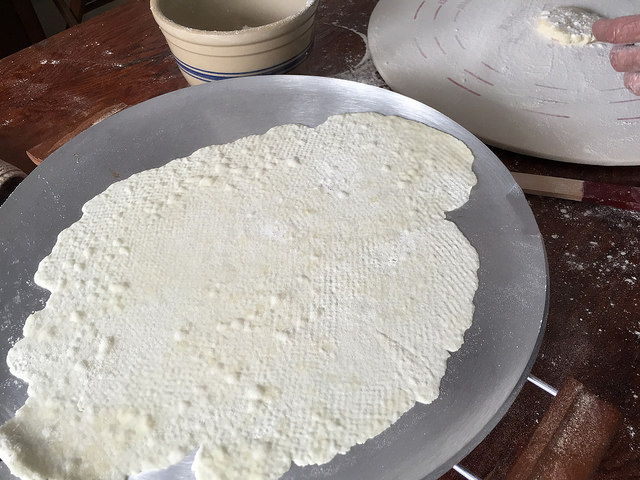
7. Once on the grill, let the lefse cook for about one minute. Then, use the turning stick to flip the lefse over on the grill. Let it cook for an additional thirty seconds.

16140674723_ef43def668_k

8. To keep your finished lefse from getting crispy as it cools, store it sandwiched between towels. The condensation created by the hot lefse will keep them soft.

The Mister and His First Homemade Lefse

9. Try not to eat all the lefse as it comes off this grill. This will be harder than you think it might be. Once you slather butter on a hot lefse and gobble it down it’s hard to stop yourself from having another. And then another. If you do end up with any leftover lefse, store them in an airtight container in the refrigerator.

While The Mister has always enjoyed his lefse simply buttered, according to a post on the Lefse Facebook page others have been known to eat it with butter and sugar, cream cheese and lingonberries and even lutefisk.

*By the way, I hope the photo at the top of this post says “You’re going to love this lefse.” Google provided the translation to Norwegian. If it turns out that I’m wrong about that, let me know!

Images: This American House


Warning: Undefined variable $post in /var/www/html/wp-content/plugins/hemlock-core/inc/social_share.php on line 22

Warning: Attempt to read property "ID" on null in /var/www/html/wp-content/plugins/hemlock-core/inc/social_share.php on line 22
architecture, Frank Lloyd Wright, Prairie School

Prairie Sale: A 1915 John S. Van Bergen House
741 Sheridan Road, Evanston, Illinois

03/17/2015

John S. Van Bergen House at 741 Sheridan Road Evanston Illinois

I’ve been in the city a lot lately due to a new day job. While I usually make the trek out to the house on Friday nights, I decided to stay in the city this weekend. I had errands to run and I needed a break from the commute out the house. We were lucky enough to get a quick taste of spring this weekend, with temperatures in the 60’s and sunny skies above. So on Sunday afternoon I pumped up the tires on my bike and took myself out to soak up some springtime sunshine.

It was on my ride that I discovered this gorgeous Prairie style home in Evanston, Illinois. The house at 741 Sheridan Road was designed by John S. Van Bergen and, judging by the photos in the real estate listing, it’s everything that I want our house to be.

John S. Van Bergen Home at 741 Sheridan Road

If you think that this house looks a lot like Frank Lloyd Wright’s designs – and indeed our own American System Built Home – you’re right. John S. Van Bergen worked for Wright in his studio in Oak Park. As part of his work for Wright, Van Bergen supervised the Robie House and the Mrs. Thomas Gale House. Hailing from Oak Park originally, Van Bergen was undoubtedly influenced by Wright’s Prairie style early in his life. In fact, according to the Wikipedia page about Van Bergen, his “mother was friends with Wright’s mother, Anna, and Van Bergen’s third grade teacher was Wright’s sister, Maginel.”

I stopped in my tracks when I came upon the house at 741 Sheridan Road. Not only am I interested in Prairie style architecture, but this particular house is for sale! I stopped, snapped a photo and then pedaled my way back home, where I immediately searched for details on the house.

imagereader (1)

The house was built in 1915, just two years before our ASB home. I can see some similarities between this house and the ASB homes that Wright designed. The wood trim and corner windows are hallmarks of the Prairie style, as are the stucco exterior and low roofline.

With a price of $1.75 million, this house is way, way, way out of our league. It is, however, a great reminder of what we want to do in rehabbing our own more modest house. We want to get the wood trim in our house stripped and refinished. And we want to have the exterior trim and windows repainted. (Speaking of, I love the green trim used on this house in Evanston, but I think we’ll probably go with a red or brown paint for our trim.)

For more information on the house at 741 Sheridan Road, check out the real estate listing at Sotheby’s.

Images: 1. This American House, 2. and 3. Sotheby’s


Warning: Undefined variable $post in /var/www/html/wp-content/plugins/hemlock-core/inc/social_share.php on line 22

Warning: Attempt to read property "ID" on null in /var/www/html/wp-content/plugins/hemlock-core/inc/social_share.php on line 22
iowa, small town life

Cars of Crude: Transporting Oil in the 21st Century

03/09/2015

Cars of Crude: Transporting Oil in the 21st Century

Sometimes there are things happening out in the word and, even though you know they’re there, you don’t really pay attention to them. Then one day something happens and your interest is piqued. Such is the case with my interest in the way we transport crude oil in America. In the parlance of so many action movies, this time it’s personal.

It started with a news story on Friday morning. I saw a headline on my morning news roundup about a train derailment near Galena, Illinois. Galena happens to be part of the route we take from the city out to the house. I clicked on the news story with selfish interest. We were going to be driving to the house Friday night so I was wondering whether this derailment would have any impact on our trip.

According to the Yahoo news story about the Galena derailment, this particular train was pulling 103 cars of crude oil, plus 2 cars filled with sand. Let that sink in a moment. 105 train cars! That’s a mighty long train! Fortunately only 21 of those cars derailed in Friday’s accident. Unfortunately, those cars still burst into flames and created ginormous explosions. Also quite fortunately, this accident occurred in a sparsely populated region of the midwest. Imagine if this derailment had occurred closer to the town of Galena or if it had occurred during the height of the summer tourism season, when more people would be in the region.

A freight train pulling hundreds of cars of crude oil

Not all of these concerns occurred to me when I read the story about the Galena derailment Friday morning. Again, I was first looking at the story from a selfish standpoint. Would the crash affect me in my trip out to the house? Later that night, however, as we made that trek to the house for the weekend, we listened to an episode of Fresh Air about the risks of transporting oil by train. Fresh Air guest host Dave Davies interviews Marcus Stern in this episode and it was truly an eye opening interview. Not only are these train accidents becoming more common, thanks in large part to he Bakken region’s oil surplus, but it seems to be just a matter of time before a derailment occurs in a more densely populated city. While the trains start their journey in a very rural region of the Dakotas, they inevitably make their way through city centers along the way.

Take into consideration the fact that the train that derailed in Galena would have travelled through Chicago on its way to refineries on the East Coast. Can you imagine the devastation that would be caused by a series of rail cars exploding in a city with a population of more than 2.5 million people?

As we listened to the Fresh Air story (not coincidentally while driving through Galena) we started thinking about the freight rail line that runs through out little town. The romantic in me has always enjoyed the echoing of the train’s horn as it lumbers down the tracks less than two blocks from our house. I had assumed that these trains were carrying corn and soybeans and other farm products. Now, knowing that the trains are pulling highly explosive materials as they snake their way through town makes me a little wary of the romance of the rails.

And then Saturday morning, as I crossed the Mississippi to pick up groceries at Piggy Wiggly in Prairie du Chien, Wisconsin, I spied the train that’s pictured above. There, sitting on the tracks along the Mississippi River, were cars of crude. I was standing near what I assume was the middle of the train. Looking left and looking right, there were rail cars as far as my eye could see. More than a hundred of them, I’m sure. This is literally getting a little too close to home.

So what’s the solution? Pipelines? Maybe. But pipelines are expensive and, really, aren’t very safe either. Stop using so much damned oil? Well, yes, that’s the most obvious solution but it’s not very practical, is it? I mean, we still have to heat our homes and drive our cars. Frankly, I don’t know what the solution is. All I know is that I am now aware of the problem. And it scares the hell out of me.

Images: This American House


Warning: Undefined variable $post in /var/www/html/wp-content/plugins/hemlock-core/inc/social_share.php on line 22

Warning: Attempt to read property "ID" on null in /var/www/html/wp-content/plugins/hemlock-core/inc/social_share.php on line 22
city boys, small town life

Winter Reality: Small Town vs. Big City Snowstorms

02/09/2015

Winter Storm Linus Hits Chicago

Last weekend, when much of the Midwest was covered by Winter Storm Linus, The Mister was at the house and I was hunkered down in the apartment in the city. As the snow piled up in both locations, we were able to recognize the vastly different experiences between small town life and big city existence.

At our house we are responsible for shoveling our own driveway and sidewalk when it snows. We haven’t yet upgraded to a snowblower so we’re still shoveling by hand. Or, at least, we try to. It seems we never get the chance to do our own shoveling because a friendly neighbor with a snowblower will show up and do it before we can. That’s small town life for you. It’s a neighborly existence where folks pitch in to help one another.

Meanwhile, back in the city, it’s every man for himself. Since we live in an apartment building, we’re not responsible for snow removal on the sidewalks. There’s a landscaping service that shows up after the snow stops falling and clears the path. That’s the good news. The bad news is that we don’t have off-street parking at our apartment. That means that our cars, along with everyone else’s, are parallel parked on the street. And when a street full of cars is covered with 20+ inches of snow, it’s one big mess.

For one thing, when the plows make their way down the side streets, they create a great wall of snow that often completely blocks the cars where they’re parked. When that happens, you’re not only digging your car out of the snow, you also have to shovel the wall of snow out of the way.

No dibs for me.

Now, if you don’t know anything about Chicago, and if you’ve never been here during a big snowstorm, you may not know about the phenomenon known as dibs. Put simply, dibs is the practice of cleaning out a parking spot for your car and then marking your territory so that your spot will still be there when you return. To someone who lives in a small town, this probably seems absurd. I mean, if everyone worked together to clear all of the parking spots on the street, then dibs wouldn’t even be necessary, right?

Oh if only that was the case! Instead, on any given block you’ll see a few cleared spots where responsible car owners have done their work. And then there will be a bunch of cars that have never been cleaned of their snow. Those cars will probably remain in that condition until the snow melts. And as the piles of snow get pushed around and about, parking becomes a real issue. If you don’t get stuck on one of the snow humps, you’re lucky.

And so the concept of dibs comes into play. Last Monday I spent almost an hour clearing my car of snow. I used a snow shovel to clear the humps of frozen slush from around my car, being sure to push the snow to the curb rather than the middle of the street. While I appreciate the concept of dibs, I have yet to embrace the practice myself. As I drove away from my nice, clean parking spot Tuesday morning, I knew that I would never see it again. And I was right. When I got back home Tuesday night, the spot has already been taken. I was forced to drive around and around until I found a spot where my car almost fit.

That’s city life for you. It’s every man for himself here in the city. And that’s exactly why we’re working toward full time life at the house in the future.

Images: This American House


Warning: Undefined variable $post in /var/www/html/wp-content/plugins/hemlock-core/inc/social_share.php on line 22

Warning: Attempt to read property "ID" on null in /var/www/html/wp-content/plugins/hemlock-core/inc/social_share.php on line 22
DIY

Real Life Lessons: Embracing the Imperfections of DIY

02/02/2015

Embracing the Imperfections of DIY

At my day job last Friday we had a Super Bowl potluck party. My contribution was this plate of bacon cheddar biscuits.

“Gee, Jason,” I can hear you asking. “Why are your biscuits two different colors?”

Oh, you noticed that, did you? Well there’s a simple reason some of the biscuits are darker than the others: I burned them. In an attempt to multi-task Thursday night, I was ironing clothes, listening to music and telling The Mister some sort of riveting story. My first batch of perfectly golden biscuits was cooling on a wire rack on the counter and the next batch was baking in the oven. I guess I was so distracted that I didn’t hear the over timer beep. Five minutes later, I caught a whiff of my biscuits starting to burn.

As I pulled the dark brown biscuits out of the oven, I spat out a few curse words and considered dumping them in the garbage. Before I did, I picked one off the baking sheet and bit into it. While the biscuit was a little crunchier than I would have liked, it still tasted fine.

“Here,” I said as I thrust a biscuit in The Mister’s direction. “Do you think I can still take these to work tomorrow?”

“Sure,” said The Mister between bites. “They taste fine to me. And isn’t that what really matters – how they taste and not how they look?”

“That’s true. But I hate showing up with a burned biscuits. I have a reputation as a good cook to uphold!”

It wasn’t until I was placing the biscuits in a container for their journey to the office that I finally decided that the burned biscuits were just fine. In fact, I finally reasoned, that the biscuits are burned is proof that they’re homemade versus store bought. When things are homemade, sometimes they’re imperfect.

And that’s the nature of doing it yourself. Sometimes things go wrong and you just have to deal with it. Whether it’s burning the biscuits or discovering that the faucet you just installed is a little too heavy for your stainless steel sink, life as a DIYer is full of surprises. It’s how you deal with those surprises that defines you as a maker. You can either say, “I suck at this! I’m never doing this again!” Or, and this is the path I recommend, you can say, “Oops, that didn’t work out so well this time. I’ll remember this lesson and really kick some ass next time!”

For the record, the biscuits were a hit.

Image: This American House


Warning: Undefined variable $post in /var/www/html/wp-content/plugins/hemlock-core/inc/social_share.php on line 22

Warning: Attempt to read property "ID" on null in /var/www/html/wp-content/plugins/hemlock-core/inc/social_share.php on line 22