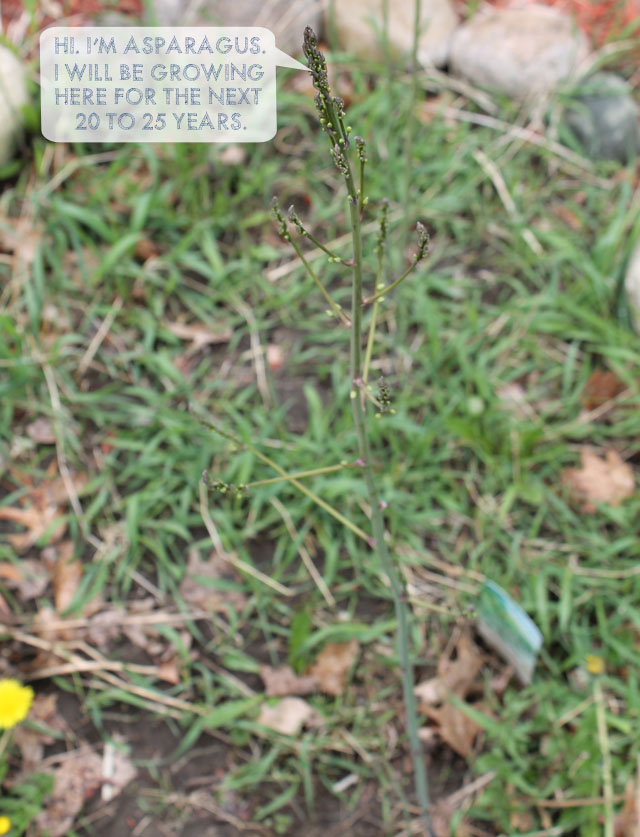
Did you know that asparagus is a perennial? And did you know that a healthy asparagus plant can continue growing for 20+ years? I certainly didn’t! In fact, I didn’t know very much at all about asparagus (aside from the obvious yumminess and after effects) until I discovered it growing in our garden.

As I mentioned in a previous post, one of the joys of owning a historically significant house is the sense that we’ve joined a club. First there was the letter from the The Frank Lloyd Wright Building Conservancy and then just a couple weeks later, we received an email from a fellow American System Built home owner. After introductions were made and pleasantries exchanged, we were invited over to tour his ASB home and compare notes.
The meeting can be best summarized by a phrase that was frequently used that afternoon – it could be worse. It was the other ASB owner, Stuart, who first used that phrase. Having seen the condition of our house via the blog, he was the first to point out that his house was in worse shape than ours.
While most of the changes that we’ll need to make are cosmetic in nature, Stuart faces a number of big renovations to return his house to its former glory. Whereas the trim in our house has merely painted, most of it was removed from Stuart’s house years ago. And what wasn’t removed was drastically altered. Based on the floor plan for our house, it doesn’t appear that any major structural changes have occurred over the years. Stuart’s house, on the other hand, has had walls put up and bathrooms installed.
Despite the hard work ahead of him, Stuart’s passion for restoring his home mirrors our own. We had a wonderful time pouring over the research that Stuart has completed. And we were delighted when he offered to let us borrow one of his rare ASB books. (“We know where you live,” Stuart’s wife joked when we asked if it was really OK to borrow the books.)
It’s easy to get overwhelmed when facing a renovation. Standing back and looking at all of the things that need to be done, trying to parse out which project should happen first, one can start to feel rather hopeless. Comparing notes with another member of the ASB club provided some comfort to us. Not only because his house is slightly worse for the wear but because it reminds us that others are trying to do what we’re doing. And succeeding! Stuart has already made great strides in restoring his home. Seeing that progress, and talking about our homes and projects, was a relief to us renovation newbies.
All this is to say a special thank you to Stuart and his family for welcoming us into their home … and to the club.
Image: This American House
At first glance, this photo may look like beaded jewelry, a bracelet perhaps. But it’s actually corn. Yes, corn. As in corn on the cob! Have you ever seen such a beautiful vegetable? It’s just one of the gorgeous specimens in NPR’s blog post Gardeners’ Gems: Designer Crops That Will Wow The Neighbors.
The corn shown above is called Glass Gem Corn. And as beautiful as it is to look at, its story is equally awesome:
The story begins decades ago with Carl Barnes, a part-Cherokee farmer and breeder in Oklahoma who started crossing different Native American corns for beauty. He chose vibrant, translucent colors and eventually ended up with Glass Gem Corn. One of Barnes’ students, Greg Schoen, gifted the seeds to Native Seeds/SEARCH, a non-profit seed conservation group, in Tucson, Ariz.
We already have our potatoes in the ground but it’s not too late to plant some of the other designer produce that’s mentioned in the post. Maybe pineberries, the pineapple/strawberry hybrid that dates back to 1750’s Europe. I mean, why settle for plain ol’ strawberries when we could have the white and pink pineberries that were saved from extinction by Dutch strawberry breeder Hans De Jongh?
Check out the full post – Gardeners’ Gems: Designer Crops That Will Wow The Neighbors – on NPR.
Image: NPR
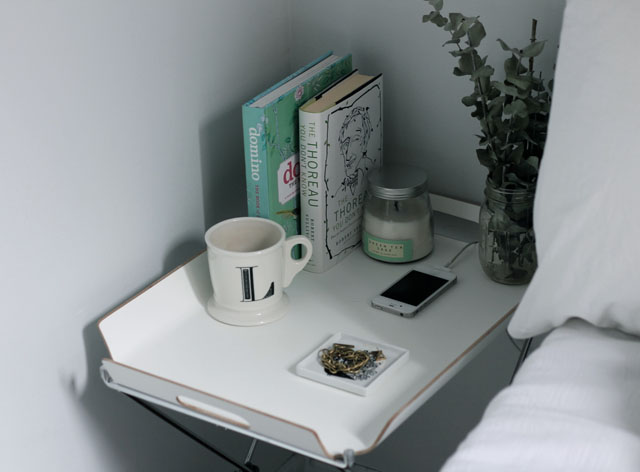
This is the second post in a series looking at what we keep on our bedside tables. I kicked off the series with a look at my own table a few weeks ago. This week we’re taking a peek inside the bedroom of Chicago-based blogger and designer Lindsay Humes.
Lindsay Humes is a very busy lady during the day. Whether publishing posts on her blog, The Garden Apt., collaborating on projects with indie retailers or designing and developing websites for small businesses, Lindsay is a whirling dervish of productivity. So when it comes time to retire at the end of the day, Lindsay likes to tuck herself away in a space that is simple and calming.
Mr. and Mr. Blandings is Now This American House
05/13/2014When we first launched this blog back in October of 2013, we were still in the process of buying our dream house. Knowing that we wanted to create a blog devoted to our adventures in making the house our own, we started brainstorming titles. After bandying about ideas for a few days, we settled on Mr. and Mr. Blandings – a title inspired by our love of the old Cary Grant/Myrna Loy film. It also seemed like a fitting title for a blog about the new lives we hope to create in our “country home.”
Now that we’ve actually been in the house for a few months, and as we’ve continued researching it and all the other American System-Built homes, we’ve started thinking about the blog differently. We always knew we wanted to write about our house projects, but we had no idea how much the house would be the star of the blog. When we thought the blog would be as much about us as about the house, Mr. and Mr. Blandings seemed like an appropriate title. Now that we’re merely the supporting players in the story of the house, it’s time to change the name of the blog completely. And so, Mr. and Mr. Blandings is now …
THIS AMERICAN HOUSE. In addition to better representing the subject of the blog, our American System-Built home, the new title also describes our passion for American design and architecture. From the very beginning, we knew we wanted to furnish the house with almost exclusively American made pieces. Then, as we started researching American System-Built homes, we began to understand that Frank Lloyd Wright and Arthur Richards were trying to create a truly American design with these houses. It’s not by coincidence that they were called the American System homes. The original marketing copy for the housing project says,
Today, there is an American Architecture. An architecture as brave and direct as the country. It is pioneer work. Frank Lloyd Wright has cut fresh trails as did the early American. He has forgotten the time-trodden roads of the older orders.
America deserves an architecture. The English, German or French home is a part of the actual country; it belongs where it is built; it fits their respective styles of living. The Italian home built on the hill side becomes part of that hill. It grows out of it. The buildings express the life of their occupants, and are national in character …
No longer do Americans have to satisfy themselves with homes that ape old world forms, that were never intended for the new America. The American System house voices American feeling. It is the expression of a national spirit. It is fresh, buoyant, vital.
American Architecture has come naturally. It has sprung up from among us. It is big with power. There is nothing artificial about it. There is no straining for effect. An American House speaks to you. It says: I am the beauty of perfect utility. The inner rightness of design and materials finds utterance in my outward lines.
Only a man who has a world-character in his knowledge and an American in feeling could have done this.
In Frank Lloyd Wright the nation has found its interpreter. Through him America is no longer the copier. America is the originator. The American House is the creation.
It’s a bit grandiose perhaps (it is marketing copy after all) but we really appreciate what Wright and Richards were trying to do. They wanted to create an American design. They wanted to build the American house. And now we own one of those American houses.
And so This American House seems like a far more fitting name for our blog. For it is the story of this house, this American house, sprinkled with tales of our trials and triumphs in restoring it.
So what does this mean for you, dear reader? Not much, really. We’ll still be writing the same posts – before and afters, product roundups and the like. You can still access the blog from mrandmrblandings.com – although you might want to change any of your bookmarks to our new URL – www.thisamericanhouse.com. While you’re at it, you might want to Subscribe to This American House by Email to get our blog posts directly in your inbox.
Thanks for reading!